Back
Back All articles

Imagine a product manager scrolling through an AI-generated summary of 50 user interviews insights, sentiment scores, and recommendations, all well and neatly packaged. It’s impressive, fast, and efficient. Yet with that efficiency something’s missing. That is often the pause before an answer, the tone that shifts with doubt, the off-script comment that sparks a breakthrough. That’s the paradox of 2025, we have more research tools than ever, but the most valuable discoveries still come from real human conversations.
Globally, user interviews remain the most trusted research method, with 86% of UX professionals regularly conducting them in 2025. Across Africa, the pattern holds true. The YUX “State of User Research in Africa” (2022) report found that individual interviews, usability tests, and surveys are the top methods among researchers in 23 countries. Yet, while 63% of organizations run user research several times a year, 62% still lack a dedicated researcher. That means designers, product managers, and marketers are often the ones leading the conversations, proof that the desire to understand users runs deep, even in lean teams.
Despite the rise of automation and AI-driven analysis, interviews and usability tests still dominate because they do what tools can’t capture human nuance. The next wave of innovation isn’t about replacing that human touch, but amplifying it. Moderated interviews remain the heart of discovery and the future lies in making them smarter, faster, and more scalable through AI support, not substitution.
The Research Method Spectrum
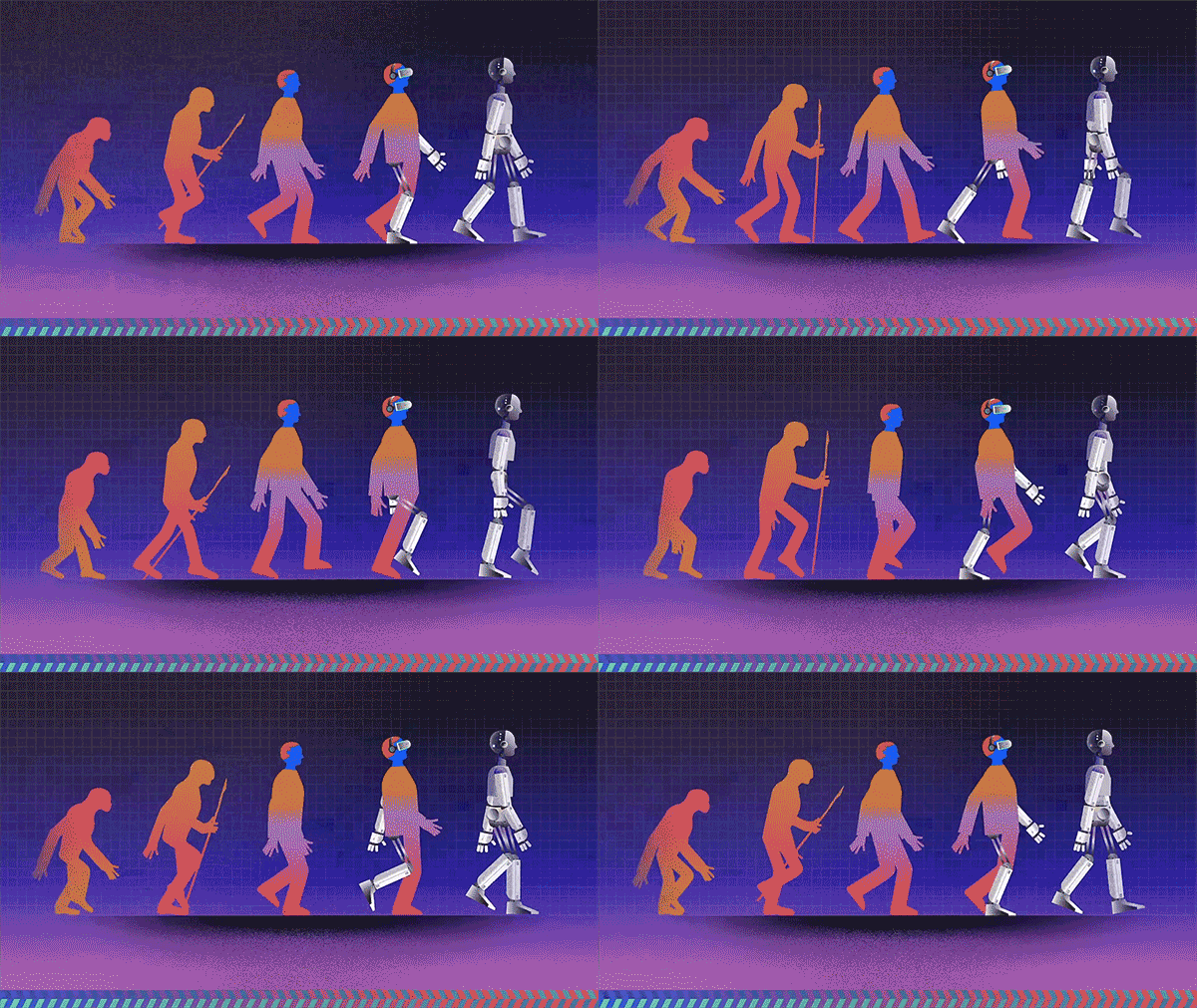
Not every research method digs for insights the same way. In 2025, we have seen most teams blending three main approaches: moderated, unmoderated, and AI-assisted research depending on how deep they need to go and how fast they need answers. Moderated interviews still lead when it comes to uncovering real motivations and emotions. They’re flexible, personal, and great for understanding why people behave the way they do. Unmoderated sessions on the other hand are built for speed and scale. You can run hundreds of tests overnight and get quick reads on usability or messaging.
The catch however is that you lose the empathy and nuance that come with live conversation. Then there’s AI-assisted research in the middle ground. It pairs automation with adaptive intelligence, helping teams analyze patterns or generate follow-up questions, but it still can’t fully read tone, emotion, or cultural cues like a human can.
The Human Edge
Even with the AI tools human-moderated interviews continue to play an irreplaceable role in research. What makes them so powerful is empathy, the ability to make participants feel understood and safe enough to be honest. When people sense judgment, they give rehearsed or surface-level answers. A skilled moderator can gently normalize confusion, use tone to build trust, and ask follow-ups that reveal what users truly think or feel. In one financial app study, participants claimed to understand investment terms until a moderator asked them to “explain it to a friend,” uncovering deep confusion that an unmoderated session would have missed. Human moderation isn’t just about asking questions, it’s about listening between the lines.
Moderators pick up on subtle cues like hesitation, tone, or emotional shifts that AI can’t yet interpret. They adapt questions in real time, diving deeper when users reveal unexpected behaviors or contradictions. This adaptability often leads to serendipitous discoveries and insights researchers weren’t even looking for. For instance, one team learned users were abandoning their shopping carts not because of payment issues, but because they wanted to compare products, something only revealed through open-ended, human conversation. While AI can help scale research, it still can’t replicate the intuition, empathy, and contextual understanding that make human moderation the heart of meaningful user insight.
AI as Enhancement, Not Replacement
Looking ahead to 2026, we can expect even smarter systems that assist in real time detecting sentiment and summarizing insights almost instantly. But even with all this progress, the goal isn’t to replace the human element. It’s to enhance it. 2025 saw the rise of AI tools that completely reshaped how research teams work, that is, from note-taking to synthesis, automation, and safe to say now part of nearly every research workflow.
The future of research is hybrid and the best teams are already finding that balance. AI can scan past studies to highlight gaps, draft interview guides, and handle live transcription freeing moderators to truly listen. After sessions, it accelerates analysis by clustering themes, detecting sentiment, and generating summaries that turn hours of footage into actionable insight.
With AI, it's more about giving moderators superpowers. And as we move into 2026, the real opportunity lies in how we integrate these tools not just to automate tasks, but to amplify human understanding. In our next article, we shall unpack how to weave AI into every stage of your moderated interview process.