Back
Back All articles

LOOKA Research, specializing in data collection, analysis, and visualization across Africa, conducted a study across Kenya and South Africa to provide swift and accurate insights into the dynamic mobile money landscape. This research focused on understanding how individuals navigate domestic and cross-border payments. The study revealed stable core patterns of mobile money usage and user preferences in Kenya, ensuring the findings' continued relevance for understanding current trends. It's crucial to note that cross-border and P2P (peer-to-peer) payments are interconnected, commonly mutually influencing each other.
While M-Pesa maintains a dominant position in the market, understanding the broader landscape requires looking beyond a single service. To delve deeper into user behavior, 16 surveyors were deployed across Kenya's urban centers, gathering extensive data. This article focuses specifically on Kenya's P2P market, highlighting key trends in mobile money usage, consumer preferences, and actionable insights for businesses. From the discerning users in Nairobi to the more relaxed approach in Mombasa, let us unpack how Kenyans manage their money.
1. M-Pesa's Market Dominance 👑
M-Pesa reigns supreme in Kenya's mobile money landscape, with an astounding 98% of users recognizing its convenience, widespreadness, and reliability. This dominance illustrates a broader trend in user behavior: once individuals become accustomed to a service, they are reluctant to switch unless presented with a significant incentive. Because M-Pesa is so popular, Airtel Money has a hard time getting users. However, this situation allows them to find out what customers truly value in a mobile money service.
2. People Will Switch for Lower Fees & Better Security
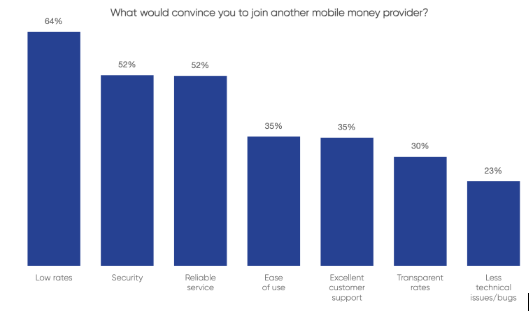
While M-Pesa holds a commanding lead, user willingness to switch for lower fees and heightened security highlights a dynamic market. A notable 64% of mobile money users would consider a change if another provider offered cheaper rates, reflecting a keen interest in cost-effective options. Security is paramount as well, with 52% of users expressing the need for a trustworthy service before entrusting their money. In short, users are telling providers, “Make it cheaper and safer, and we'll come.”
3. Mobile Money is a Daily Necessity
For Kenyans, mobile money is not a luxury; it has become an essential part of everyday life. Nearly half (44%) of users engage with mobile money daily, primarily for shopping (53%), paying bills, and sending money to family and friends. Over seven out of ten people have been using mobile money for more than five years. This shows it's a regular part of their lives. For businesses, this means it's a basic way Kenyans do money transactions.
4. People in Nairobi Complain More than Mombasa
Customer satisfaction varies significantly across regions, revealing a difference in expectations. There's a big difference in satisfaction; 78% of Mombasa users are happy with mobile money, but in Nairobi, it's just 44%, and they are looking for improvements. This disparity suggests that urban dwellers in Nairobi expect faster transactions, better support, and fewer technical issues. This could be likely attributed to Nairobi’s high digital literacy compared to elsewhere in Kenya. For service providers, addressing these regional differences could be necessary for enhancing user experience and enhancing loyalty in markets with higher expectations.
5. Mobile Money & Cash are preferred when shopping
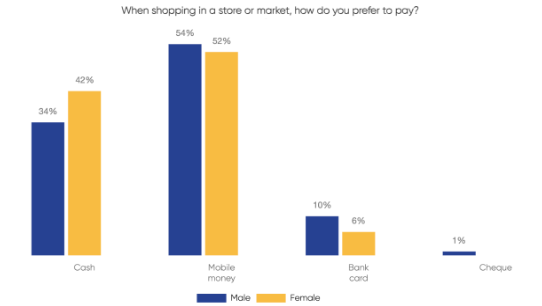
It's interesting to note that despite a high smartphone adoption rate (92%), gender continues to influence mobile money usage. When it comes to shopping transactions, mobile money remains the most popular option (54% of men and 52% of women). Furthermore, only 34% of men utilize cash, compared to 42% of women. This implies that women are more likely to rely on money.
Furthermore, employment status also plays a role. Individuals who are not currently working show a higher likelihood of using cash for shopping, while those who are employed tend to prefer mobile money. This adds another layer to understanding consumer payment behavior, indicating that both gender and occupation are relevant factors. To effectively design and market payment services, further research is needed to understand the underlying reasons for these observed differences.
6. Sending & Receiving Money from Abroad is Still Rare
Despite the potential for growth, cross-border transactions remain uncommon among mobile money users, with 68% stating they have never sent or received money from outside Kenya. High costs and a lack of awareness about the processes involved may discourage many users. Interestingly, those who do engage in cross-border transactions often find them highly relevant. Only 49% of business owners send money out, while 56% of families receive funds from abroad. Through educating users about international transfer options, service providers can tap into this underutilized segment of the market.
To maximize growth in the mobile money sector, particularly within the untapped cross-border market, providers must prioritize educating users about the benefits and security of these transactions. A thorough understanding of demographic preferences, such as women's preference for cash due to its perceived reliability, will enable the development of tailored services that resonate with diverse user needs, driving both adoption and expansion. For a deeper dive into these findings, click here to get more information.